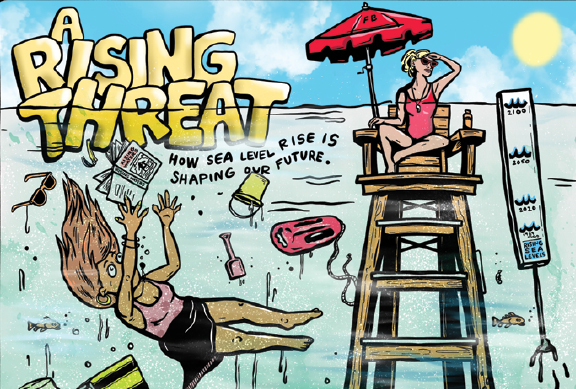
How sea level rise is reshaping our future
by Hanalei Potempa | Contributing Writer
Dubbed “the Edge of America,” Folly Beach is a barrier island that is increasingly vulnerable to the effects of the changing climate—particularly rising sea levels that threaten to reshape both its shoreline and way of life.
In his latest book, Rising Waters, local author and four-time Pulitzer Prize finalist Tony Bartelme investigates the slow-moving yet relentless threat of climate change, with a special focus on Folly Beach and the surrounding Lowcountry areas.
Bartelme’s inspiration for the book came not just from his many years of climate reporting, but from a personal realization: that the climate crisis, though ever-present, often fades into the background amid constant breaking news and political noise.
“We tried to look as best we could look at the climate crisis in a new and novel way, and that was really the inspiration — these constant distractions that we always get and then realizing that you know this thing isn’t going away and it affects every single one of our readers,” says Bartelme.
That realization inspired Bartelme to write Rising Waters, an effort to bring the issue of climate change to the forefront. The book is compiled from years of reporting and countless climate-related stories for the Post and Courier.
“We saw this connectivity between them all, and so the book really is a result of all of those climate projects that we’ve done over the last decade,” says Bartelme.
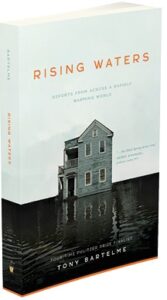 One of the book’s most striking sections follows Bartelme’s reporting trip to Greenland, where he explores how the enormous sheets of ice—massive enough to exert its own gravitational pull—has a surprising connection to sea levels on Folly Beach.
Bartelme explains that this gravitational effect works much like the moon’s pull on tides.
“Greenland’s ice pulls the tides, pulls the ocean a little bit toward it, and that pulls the water away from our coast, lowering our sea level. But if that ice melts, then the water sloshes back and our sea level increases,” he says.
On Folly Beach, this means not only more frequent flooding but also accelerated erosion—both on the beachfront and on the marsh side of the island.
“A lot of people don’t really think about erosion on the marsh side, but that’s where a lot of these fraying edges are, is on the marsh,” says Bartelme.
Despite the dire projections, Bartelme emphasized the importance of climate change discussions to focus on solutions. He’s observed that the issue of climate change can often invoke a sense of fatalism and defeat.
“I’ve tried to focus on the beauty of the world and maybe even a little bit of humor here and there to take a bit of the edge off so people can be a little more open-minded,” says Bartelme.
Looking to the future, Bartelme calls for “marrying hope with action and realism,” an outlook grounded in both urgency and practical optimism.
Folly Beach residents are already putting this mindset into practice, with several solutions actively in progress.
Elko Coastal Consulting, in collaboration with the College of Charleston and the S.C. Sea Grant Consortium, released a major update to its climate planning report: Folly 2050: Planning for Water. This six-year follow-up to the city’s 2017 Sea Level Rise Adaptation Plan outlines new climate data, updated infrastructure strategies, drainage improvements, and policy updates.
Among the plan’s key strategies are living shoreline pilot projects, expanded dune restoration, marshfront mapping, and community-based flood monitoring—a comprehensive approach to safeguarding Folly Beach’s vulnerable ecosystems. With sea levels projected to rise at least 1.6 feet by 2050, the city is blending green infrastructure with adaptive policy and public engagement.
Nicole Elko, President of Elko Coastal Counseling, shared that one of the main concerns observed when comparing the 2017 planning water report to the updated 2023 report, was the significant rise in King Tide events.
One of the report’s most alarming findings is the sharp rise in king tide events—naturally occurring, exceptionally high tides that are becoming more frequent due to sea level rise.
“Folly had something like 90 king tide episodes in 2024, compared to maybe a dozen just a few years ago,” says Elko.
The report also projects that today’s average high tide water level of two feet could reach an average of 9.5 feet by 2050.
“The projections are showing that we’re going to have about a foot of sea level rise in the next five years, and then we’re going to have about a foot of sea level rise in the next five years,” Elko says. “And so that’s pretty significant and palpable to the community, right? I think a lot of people around here can think, ‘imagine 2050.’”
Elko stressed the need for more attention to the marshfront, which is likely to feel the effects of rising water first. Long-term restoration projects—similar to the city’s ongoing beachfront efforts—are now being planned for the marsh as well.
Flooding is a familiar challenge for Folly Beach residents—but as sea levels continue to rise, those events are expected to become both more frequent and more severe. Elko emphasizes the importance of “on-site stormwater management,” encouraging homeowners to take proactive steps on their own properties.
“Trying not to divert your runoff to the streets, trying to keep it on your lot by capturing it with rain barrels, rain gardens, using permeable surfaces instead of impermeable concrete, making sure your roof line isn’t dumping out into the marsh — so lots of small changes the community can help with to manage water,” she says.
Despite the challenges, Elko says the community has remained actively involved and forward-thinking.
“I think [on a national scale] Folly is really ahead and they’re very progressive when it comes to looking at these types of things. They’re installing one of the first living shorelines in the state and I’m just really proud of the resilience efforts,” says Elko.