
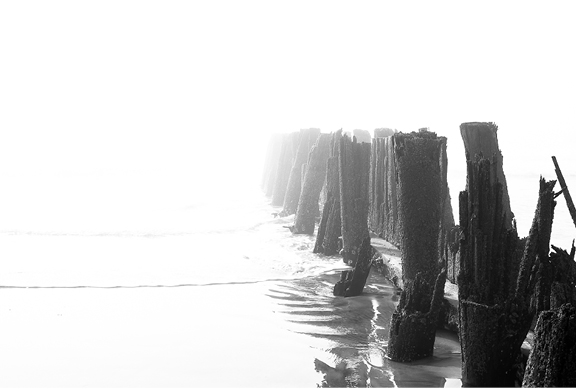
While it creates some navigational challenges, fog is also cool … literally
 We’ve had our fair share of foggy mornings (and full days!) recently. Some people have told me the fog feels claustrophobic, but I’ve always thought fog was magical. It feels unending, similar to the open ocean. You don’t know what’s around the next turn — a dolphin or a crab trap or the outstretched limbs of a tree reaching over a creek. But it’s more than that. There are infinite possibilities of what’s to come, and there’s no point looking behind you to see where you’ve come from. It forces you to literally be in the moment.
Fog forms when the air becomes saturated with water as the temperature reaches the dewpoint, causing it to condense into water droplets. It’s a simple process with the potential for complex consequences — especially on the coast.
When I was 18 or 19 and home from college for Christmas break, a friend and I went surfing. It was a grey shapeless day (not unlike the weather as I write this). Cold, damp air, large waves breaking in a soggy mess. We couldn’t be picky then and dutifully pulled on our wetsuits and paddled out. It wasn’t long before a fog bank rolled in so thick we couldn’t see the shore or waves approaching behind us. A set caught us inside and we tumbled a bit before catching smaller waves back to the beach. It was exhausting, freezing, and exhilarating. Since that day I’ve loved going for a foggy walk, paddle, or boat ride – in small familiar creeks of course. Lesson learned on the ocean.
There are multiple types of fog, but we are usually affected by radiation, advection, and evaporative fog. Radiation fog occurs at night as the Earth cools and releases heat back into the atmosphere. Pockets of colder air can accumulate near the ground and if the humidity is high enough, create condensation.
Sea fog is a type of advection fog that occurs as warm humid air moves across colder water or ground. The cooler water chills the air just above the surface and creates fog. Evaporation fog occurs when cold air travels over warmer water. As the warmer water evaporates, it saturates the low, cold air and creates condensation.
Regardless of type, fog is a serious navigation hazard whether traveling by boat or car. If you’ve driven over a bridge during the fog the last few weeks you know what I mean! After the surfing incident I have been cautious about bigger boating trips when conditions may cause fog.
One 80-degree December day a few years ago I went to fish a nearshore reef just a mile or two out. The day was perfect; glassy water, light breeze, not a cloud in the sky. Around 11am we saw the fog bank approaching from offshore and lost the race back to the inlet. The Stono Inlet is one thing in good conditions when you can read the water, but in a dense fog without visual cues it was impossible.
We anchored off the county park and waited. After a while the fog rose enough for us to see we were maybe 30 yards from shore and we were able to sneak most of the way back in before the white veil descended again. Lesson learned. Again.
Fog may feel magical, but it deserves respect. Slow down, use your lights, listen closely, and don’t chance it with the weather forecast. And if you’re lucky, it’ll lift at just the right moment to reveal the beauty of the Lowcountry!
Found something and want to know more about it? Send a photo to saltmarshadventure@gmail.com for help identifying and a chance to be in the next Creature Feature!