Folly Beach poet Layle Keane Chambers wins 2026 Elizabeth Boatwright Coker Fellowship in poetry
by Hanalei Potempa | Contributing Writer
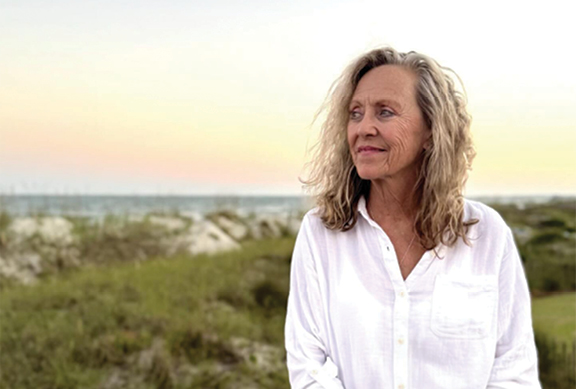
Layle Keane Chambers, a local Folly Beach resident, was recently awarded the 2026 Elizabeth Boatwright Coker Fellowship in Poetry by the South Carolina Academy of Authors. Around the same time, her debut poetry chapbook, Caught in the Light, was released—marking a major milestone in her literary career.
Although Chambers initially pursued theater in college, writing had always been a constant in her life. After getting married and having her son, she found her way back to poetry, eventually committing to the craft through formal study.
“I went back and got a second master’s degree, an MFA in Creative Writing, and I really began to dedicate myself to writing,” Chambers says.
Her return to writing coincided with a deeply personal chapter in her life. As her son began the process of becoming an Air Force pilot, Chambers found her experience as a military mother shaping the emotional core of her work.
This influence is especially evident in her poetry collection The Series of Liminality, which earned her the Elizabeth Boatwright Coker Fellowship. The collection explores the emotional tension of living in an “in-between” state—caught between pride and fear, love and uncertainty.
“The military mother is always in between intense pride and love, and also an equally intense concern and anxiety, and kind of always living sort of in the nether regions of life, never really knowing for sure what may be happening next,” Chambers says. “So these poems sort of investigate the effect of a life in the middle and kind of in the in between.”
Chambers said it was particularly meaningful that the judges recognized what they described as an “unspoken but omnipresent love” within her work.
“It is absolutely the driving force of everything that a poet does — it is some form of love that drives writing poetry,” she says.
That sense of place and emotional grounding is deeply tied to Folly Beach, where Chambers lives and writes. For her, the island is more than just a home—it is a language.
“It’s the language that I use to translate my experience as a human being, and the geography of Folly Beach shows up in all of my poems.”
From the marsh and tides to the lighthouse, dolphins, hawks, and alligators, Chambers frequently weaves the natural landscape of Folly into her work. The island’s beauty and rhythms provide a rich field of metaphor and reflection.
She also points to the ocean as a natural gathering place for introspection and creativity, noting how people are drawn there to process emotion.
“I’m always observing. I’m always watching life. I’m always noticing things and then collecting those ideas.”
At its core, Chambers’ work extends beyond her personal experience, using metaphor to connect with universal themes—particularly the experience of watching a child grow into independence.
“I mean his vocation as a pilot can also just be seen metaphorically as watching your child take flight into their their lives as an independent individual, and so it really can sort of be for anybody that’s ever had that experience, because that’s what poetry does — it strips away all the all the exposition, and it leaves you with the raw emotion that we can all relate to,” Chambers says.
Today, her son is a C-17 pilot, based in Charleston. They fly over Folly Beach daily.
“I feel like these poems speak to anyone who’s ever loved anyone and stepped back to watch them fly.”
Chambers draws inspiration from a wide range of writers, both historic and contemporary, including the beloved classic Rainer Maria Rilke and contemporary Gwendolyn Brooks.
Beyond her own writing, she remains deeply engaged in the local arts community, teaching workshops and encouraging others to explore their emotions through writing.
“I mean, when I first started writing about my experience as a military mom, I often said I wrote my fear into the world. And when you write your fear into the world, it becomes something you can see and you can deal with and you can toss it away.”
Interested readers can explore more of Chambers’ work at www.laylechambers.com.