
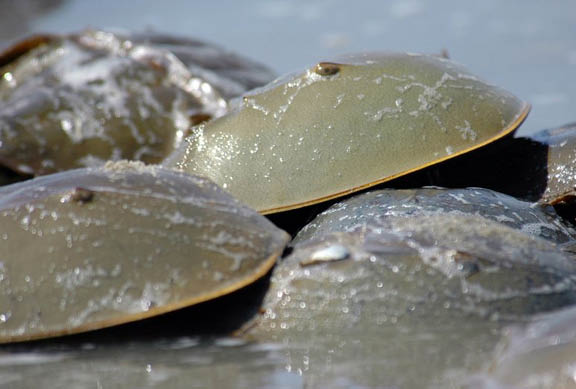
Lawsuit seeks federal protections for horseshoe crabs found along SC coast
from Staff Reports
A coalition of conservation organizations is asking a federal court to require the Trump administration to reconsider protections for the American horseshoe crab, a species commonly found along South Carolina’s coastline and one that scientists say is increasingly under pressure from habitat loss and commercial harvesting.
The lawsuit, filed May 28 in U.S. District Court for the District of Columbia by the Center for Biological Diversity, challenges a February decision by the National Marine Fisheries Service denying Endangered Species Act protections for the species.
Although often mistaken for crabs, horseshoe crabs are ancient arthropods that have existed for more than 450 million years, surviving multiple mass extinctions. Each spring, they emerge from coastal waters to spawn on sandy beaches, where thousands of eggs become an important food source for migratory shorebirds making their annual journey north.
Conservationists say those spawning events have become less common as horseshoe crab populations have declined sharply over the past several decades.
According to the Center for Biological Diversity, populations have fallen by more than 70% in some areas because of habitat loss and increased harvesting. Horseshoe crabs are collected for use as bait in commercial eel and whelk fisheries, while biomedical companies capture the animals to extract their distinctive blue blood, which is used to test medical devices and injectable drugs for bacterial contamination.
The organization says more than one million horseshoe crabs were harvested in the United States in 2024, nearly double the number taken seven years earlier, despite the availability of synthetic alternatives that are already approved and widely used in Europe and parts of Asia.
“Horseshoe crabs have survived meteor impacts and ice ages, but they’re facing their biggest threat yet: us,” said Danny Waltz, a senior attorney with the Center for Biological Diversity, in a statement announcing the lawsuit.
The group argues that declining horseshoe crab numbers also threaten other coastal wildlife, including the federally threatened red knot, a long-distance migratory shorebird that depends heavily on horseshoe crab eggs during its 19,000-mile migration between South America and the Arctic.
The lawsuit stems from a 2024 petition submitted by the Center and 25 other organizations requesting Endangered Species Act protections. Federal officials rejected that request earlier this year, prompting the legal challenge.
If successful, the lawsuit would require federal wildlife officials to revisit whether the species warrants protection under the Endangered Species Act. Such a designation could lead to additional safeguards for horseshoe crabs and their coastal habitat.
For coastal communities like Folly Beach, where healthy beaches support both wildlife and tourism, the outcome could have implications that extend well beyond one of the ocean’s oldest surviving species.