
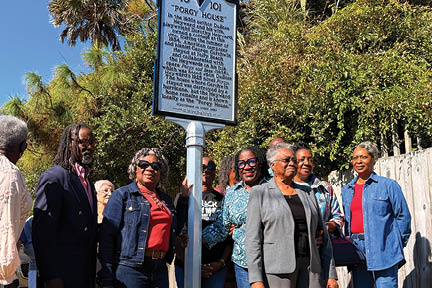
New historical marker recognizes Folly Beach home where an American classic took shape
from Staff Reports
Folly Beach has always attracted its share of characters, artists, writers and musicians. More than 90 years ago, one of America’s most famous composers was among them.
Now, a new historical marker on West Ashley Avenue makes sure that chapter of Folly history doesn’t go unnoticed.
The City of Folly Beach, Folly Beach Historical Society and Folly Beach Tourism and Visitor Promotion Committee unveiled the marker Sept. 25 in front of the Porgy House at 712 West Ashley Ave. The home served as the summer retreat of author DuBose Heyward and his wife, playwright Dorothy Heyward, and became closely connected to the creation of George Gershwin’s Porgy and Bess.
Built in 1933, the two-story cottage was the Heywards’ Folly getaway during a very different era on the island. The following summer, Gershwin came to Folly to work with the Heywards on an operatic adaptation of DuBose Heyward’s 1925 novel Porgy.
The collaboration had begun earlier in 1934, but Gershwin spent several weeks that summer on Folly, where the collaborators could work while he immersed himself in the culture and music of the Lowcountry. According to the Library of Congress, Gershwin and the Heywards observed local customs and listened to African American music during his stay, experiences that influenced the work that would become Porgy and Bess.
And Folly itself became part of the story.
The Heywards called their island retreat “Follywood,” a name that appears on correspondence between DuBose Heyward and Gershwin from 1934. That correspondence is now part of a Folly Beach Historical Society exhibit devoted to the house and its place in the creation of the opera.
Gershwin stayed in a separate cottage nearby while working with the Heywards. That house was later destroyed by a hurricane, but the Heywards’ cottage survived and became known locally as the Porgy House. City documents prepared as part of the historical-marker project describe it as the surviving Folly connection to the collaboration.
The home retains its original wood interiors, three bedrooms and a small writer’s booth that was added later and used as a workspace. Its survival is particularly notable on an island where hurricanes, development and generations of rebuilding have erased many remnants of early Folly Beach.
The Sept. 25 ceremony also acknowledged an important part of the story that stretches beyond the island. Members of the Smalls family attended the unveiling in recognition of Samuel Smalls, the Charleston man who inspired Heyward’s character Porgy.
Speakers at the ceremony included Folly Beach Mayor Chris Bizzell, James Ward of the American College of the Building Arts, Mae Holmes of the Exchange Club, Nancy Moore of the Tourism and Visitor Promotion Committee, Anne Hughes of the Folly Beach Historical Society, community representative Cubby Wilder and a member of the Smalls family.
Porgy and Bess opened in 1935, introducing songs that would become part of the American musical canon, most famously “Summertime.” But tucked into the history of the production is a distinctly Folly chapter: a famous composer spending a summer on a still-rustic barrier island, working, listening and absorbing the sounds around him.
More than nine decades later, the house is still there.
And now, anyone passing 712 West Ashley Avenue has a sign telling them why it matters.
Those interested in digging deeper into the story can visit the Folly Beach Historical Society’s exhibit, The Porgy House: A Cottage on an Island in a Culture, at the Folly Beach Community Center and Library.