
Celebrating the unsung heroes of our waterways
Part 1 of 2 on the importance of oysters
 This month we’re diving into the unsung heroes of the estuary: the Eastern Oyster, Crassostrea virginica.
Critical habitat? Check.
Erosion control? Yup.
Filtration system? Top notch.
Hungry? Bring them on!
Oysters are a keystone species, meaning that they play a disproportionately large role in the ecosystem. If something affects their population, the entire salt marsh feels it.
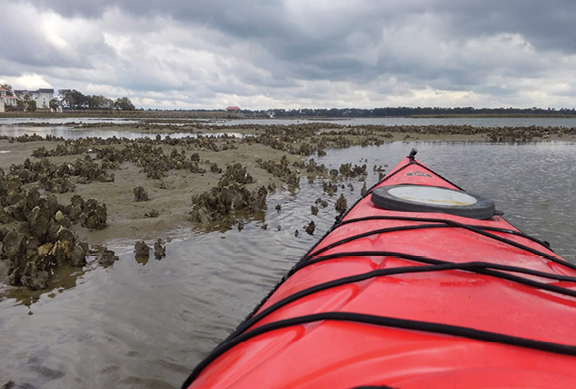
Oysters are bivalves (two shells held together by a muscular “hinge”) that live on the mud throughout the intertidal and shallow subtidal zones. They’re filter filters, feasting on all manner of microscopic bits floating by. As they filter food from the water column, they also ingest anything else present. Gas spilled from a nearby roadway? They’ll filter that out too. One oyster can filter up to 50 gallons of water a day (remember ours are only under water around half the day).
Oysters also take in naturally occurring and generally harmless bacteria and plankton. When concentrated in an oyster, some of these organisms can make us sick. One reason our water is so dark in summer is the huge amount of phyto and zooplankton present. As temperatures drop, so do plankton levels. Look in the creeks in January and February and you’ll see several feet deep, compared to an inch or two in summer.
Oyster season here pretty much follows the old rule: “Months that end in R.” That’s partly due to reduced bacteria loads, but also to give oysters time to reproduce in summer. Eggs make an already weird food even weirder!
Oysters are broadcast spawners—they release heaps of eggs and sperm into the water and hope for the best. Larvae float through the water column until they find something hard to grab onto and latch on to become ‘spat.’ Preferably another oyster, but they aren’t picky and anything solid will do. Oysters naturally grow in clusters where the largest individual is a female and all the rest are male. If she dies, the largest male becomes the new female. Oh my!
It can take several years for oysters to reach harvest size. Beds are closely managed by SC Department of Natural Resources to ensure good water quality (so we don’t eat oysters from polluted water) and to monitor populations to prevent overharvesting. You can check which areas are open/closed on their website.
Overharvesting is a global issue. In the 1700s, naturalists reported finding oyster blades six inches long in the Chesapeake Bay. Scientists believe that today’s oyster population is 1 percent of its historic size. Thanks to careful management, they’re making a remarkable comeback.
Locally, you can drop oyster shells at a recycling site, where DNR collects and cleans them to use as substrate for new oyster beds (because those babies need something to grab on to). There are several sites around Folly Beach where the shells were barged out and sprayed across a mudflat. Today mature oyster beds are there! The SCORE program (South Carolina Oyster Restoration & Enhancement) packages shells into bags that volunteers stack like bricks along the shoreline. It’s a great hands-on way to get involved.
Oysters may not look like much—and their razor sharp edges may not play nicely—but they are vital to our salt marsh ecosystem. We didn’t even get to the habitat building powers, erosion control, or their role in the local economy! I could talk oysters all day, but you’ll have to visit us on the boat for the full experience. Or wait till the next issue for part two!
Found something and want to know more about it? Send a photo to saltmarshadventure@gmail.com for help identifying and a chance to be in the next Creature Feature!