
The importance of oysters is immeasurable
Part 2 of 2 on the importance of oysters
 Are you ready to learn more about the humble oyster!? Because I’m excited to talk about them!
Here’s a quick refresher in case you missed Part 1 last month. Oysters are a keystone species in the estuary, meaning they play a big role and losing them would cause a shift in estuarine dynamics. They are filter feeders and can take in any pollution/contamination in the water, so we need to be mindful of not consuming oysters from polluted waterways. Overharvesting has been an issue, and oyster populations are drastically lower (by 99 percent in some areas) than they were a few centuries ago.
Fortunately, the South Carolina Department of Natural Resources’ (SCDNR) restoration projects and careful monitoring are giving our wild populations the leg-up they need. We’ll pick up here and look at how oysters provide habitat and make sustainable contributions to the local economy.
These small but mighty bivalves are powerful ecosystem engineers, adding 3D structure to the otherwise one-dimensional mudflat landscape of our creeks. This creates an infinite number of nooks and crannies for more estuarine species than I can count. Small fish like gobies, blennies, minnows, and juvenile species such as croaker and red drum can work their way into the cracks while larger fish use an oyster cluster to hide behind.
Pick up a cluster, and more than likely, a small crab will scurry up a blade, wondering why he’s suddenly flying. Look at the surface of the oyster itself, and you’ll find just as many invertebrate species: barnacles, algae, bryozoans, sponges, and worms, to name a few. Empty shells washed up on the beach often bear signs of these tiny residents, as many continue to use the shells as habitat even after the oyster dies.
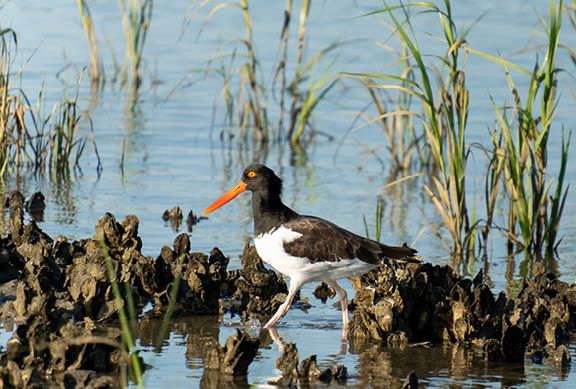
If you enjoy eating oysters, you’re not alone. Bivalves are a common prey item in the estuary for fish (anyone like sheepshead fishing?) and birds alike. The American oystercatcher is a specialist that uses its long, popsicle-stick-shaped bill to work into a slightly open oyster and clip the adductor muscle that holds the two halves of the shell together. Lunch!
Last month, I mentioned that we only eat local oysters during cold months. But what about the local singles on the menu throughout the summer? Not to worry. Farm-raised oysters play by slightly different rules. Most are triploid—they have one extra set of chromosomes than a “normal” wild oyster and are therefore sterile. This ensures they don’t genetically mix with wild populations. But it also means all the energy usually put into making eggs is now put into making oysters.
Farmed oysters are kept in cages underwater, allowing them to eat and grow more rapidly than intertidal oysters. Continuous submission and water flow prevent a buildup of bacteria and toxins, so they’re safe to eat year-round (and oysters are tested regularly to be safe).
You may be thinking: Wait! You said oysters like to grow in clusters, how are these the perfectly formed singles served at a raw bar? Good question! The cages are frequently shaken to ensure they don’t “grow together.”
Local singles are becoming increasingly popular. There are currently 22 oyster mariculture permits in South Carolina, split between bottom and water column cages, with two farms in the Charleston area. SCDNR estimates oyster mariculture contributed more than $13 million in economic output in 2024. This does not include wild oyster harvest! Mariculture takes pressure off the wild populations and can help sustain sustainable fishing practices into the future.
I hope you enjoyed learning more about oysters. Give them a nod of thanks next time you’re enjoying a local oyster roast!
Found something and want to know more about it? Send a photo to saltmarshadventure@gmail.com for help identifying and a chance to be in the next Creature Feature!