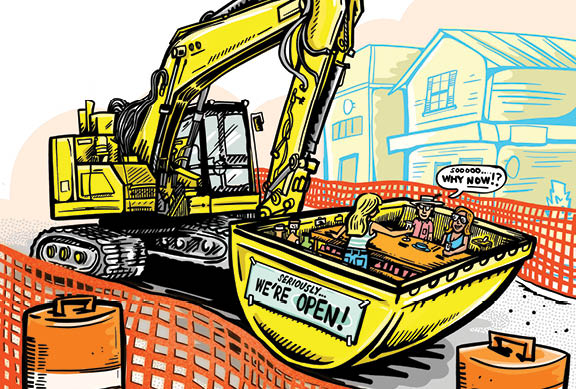
As the Center Street Stormwater Infrastructure Improvements Project nears completion, many businesses are still reeling from lost revenue during a summer mired in construction. Often, visitors to Folly had to navigate a labyrinth of building materials, temporary fencing, and rerouted sidewalks just to get to their favorite breakfast or lunch spot. There has also been virtually no parking along Center Street during the busiest months of the year, forcing some visitors to not even bother coming to Folly at all.
Even still, Folly Beach Mayor Chris Bizzell said the traffic counter on the bridge has logged more cars coming and going this year than at the same time last year. He also pointed out that occupancy rates on Folly home rentals are also slightly up this year despite the construction, according to AirDNA, a tool that tracks performance metrics using data from platforms like Airbnb and Vrbo.
But Bizzell acknowledges that these statistics do not mean that business is up along Center Street where the construction has been concentrated during the most inopportune time of the year for restaurants and shops who rely on that increase in visitors to sustain them through the leaner, cooler months.
To say it has been challenging for some local businesses is an understatement. Not only are owners already dealing with rising rent, skyrocketing food costs, high gas prices, and inflation, but they’ve also been asked to bear the burden of lost revenue as a result of the ongoing construction, which has unfortunately lingered longer than most expected.
“We’ve had days where the sidewalks are basically non-existent. Guests have had to jump through hoops just to get to us,” said Perry Freeman, owner of Coconut Joe’s on the corner of Center Street and West Ashley Avenue. “It’s been our slowest Summer since being open on Folly, and it’s not even close.”
At the opposite end of Center Street, The Washout has faced similar challenges, with construction significantly hurting business.
“Since our open patio is so close to the street, the dust and noise have scared away many clients. I have personally observed people entering the restaurant only to leave shortly after because the noise and dust were too overwhelming,” said owner Greg Marshall, who noted that the impact was much more pronounced during lunch hours than during dinner hours when crews were not working. “Additionally, I noticed many people walking on the other side of the street, bypassing the restaurant altogether as access did not feel inviting.”
That’s not to say that across Center Street things have been any better for the restaurants and shops on the East Side of the road.
“There’s no sugarcoating it; this construction has thrown a wrench into things,” said Drop-In owner Kristina Ogden. “Traffic on Center Street has been a mess, and we know some visitors have shown up ready for a beach vacation only to be greeted by dust, detours, and no place to park.”
It’s not just the restaurants who have felt the squeeze either.
“We have struggled in the past because our office is outside of the tourist loop,” said Richard Brendel, who owns Flipper Finders, a boat tour and kayak rental company located when you first come onto the island. “When you add the construction, the tourists don’t know where to go.”
Despite this, Brendel said his company has done OK this summer, but noted that most of his business has come from pre-booked online reservations or over the phone.
“I have definitely had less walk-up traffic,” said Brendel, who added that he’s used this year to remodel the shop.
Most agree that the project, which has been long planned and long overdue, is vital to Folly’s future and will be a major improvement, both functionally and aesthetically. But that hasn’t stopped many from venting their frustrations, either online or complaining directly to the mayor and city council, or hanging banners outside their shop that proclaim they’re still open for business, but openly questioning the wisdom behind doing this kind of work during the busy season.
“On a positive note, I believe the changes will ultimately be beneficial for the business in the long term,” said Marshall of the massive project, which involved installing large new underground storm drainage pipes and new stormwater lines and check valves to clear standing water after high tides or downpours, constructing bioretention cells (rain gardens) to absorb runoff, adding permeable parking spaces, and repaving the asphalt, adding pervious PowerBLOCK pavers, reinstalling engraved commemorative bricks, planting additional palmetto trees, and upgrading street lighting.
“It’s not glamorous. But we also know this project has been a long time coming, and Folly will be better for it,” said Ogden. Like Brendal, she noted that Drop-In’s business has been solid this summer, in spite of the construction. “That said, it does make us wonder how much more those numbers could have grown if visitors hadn’t been deterred from coming to the island in the first place.”
That has not been the case just down the street at Shoobie’s Ice Cream, where owner Cody Brooks says the pain has been very real for him and his family.
“This summer’s Center Street construction had a significant impact on our business,” said Brooks, who, like Freeman and others along Folly’s main drag, questions the timing of the project more than anything.
Brooks also owns The Pineapple Hut, across the street between West Erie and West Cooper avenues. Next to the Pineapple Hut is Surfer Betty, a newcomer to Center Street this year. It has not been the summer that co-owner Melissa Anderson was hoping for when she set up her cute boutique trailer just off the sidewalk and opened for business.
“This would be the time of year that we would be squirreling away money. And now we’re having to be creative,” she said. “This year more than any year it’s important to support your local businesses on Folly.”
Either deservedly or not, local officials have been forced to endure the brunt of the ire from business owners, many of whom are not pleased with the timing of the project. Whether or not it could have been avoided doesn’t seem to matter much to those who missed their one chance to lasso the summer tourist herd when they were here.
“We knew this was going to be about a 16-month project,” said Mayor Bizzell, noting that meant one summer was going to be impacted no matter when the construction began. He called it one of the biggest infrastructure projects that Folly has ever undertaken and further explained that the timelines are dictated by the grant source, not by the city.
“When you get the money, it has to be utilized. We’re looking at what, $12 million? Folly Beach can’t foot that bill,” Bizzell said. “We needed outside funding on that one.”
Around $8 million of that amount was allocated from the South Carolina Infrastructure Investment Program (SCIIP) and administered by the South Carolina Rural Infrastructure Authority (RIA).
“They kind of manage that timeline and how the money is spent and when it is spent,” said Bizzell. “So we don’t have a lot of latitude to say, ‘you know what, we’re going to hold this up for 6 months and then come back after the season.”
This is little consolation to business owners dealing with the pain of progress right now.
“From what I understand, the project needed to be completed over the course of a single summer. Whether that was the only feasible approach or if there were opportunities to lessen the impact on local businesses, I can’t say with certainty,” said Brooks. “What I can say is that the disruption resulted in a substantial financial loss for us during what is typically our busiest season. Like many small businesses, we rely heavily on the summer months to carry us through the rest of the year.”
Coconut Joe’s Freeman is even less diplomatic in his criticism, calling it “one of the dumbest, most irresponsible construction jobs” he’d ever seen from a timing and government standpoint.
“Folly leadership has just told us, plain and simple, sorry. They ‘sympathize’ with me. It’s for the ‘greater good.’ We are ‘in this together.’ Well, it doesn’t feel that way. You don’t pay bills with that,” said Freeman. “And if it is so, then why aren’t they doing anything remotely to help?”
Freeman suggested temporarily lifting the hospitality tax to promote business could have helped. Brooks offered the idea of creating an impact assistance fund or similar program to help offset some of the losses experienced by those directly impacted by the construction.
“Looking ahead, I hope this experience encourages conversations about ways to better support businesses during major infrastructure projects,” said Brooks.
Planet Follywood co-owner DJ Rich has a unique perspective in that he owns a business on Center Street, but also serves on City Council.
“Look, originally it was going to be 18 months. Then it was 14 or 15,” Rich said. “Then the company doing the work was like, ‘Hey, we can probably do it in nine.’ So we all had that in our head, and we got our hopes up. But we always knew this was most likely going to be a 12–16-month project.”
Rich said that the contractors ran into some unexpected surprises once they started unearthing the decades-old pipes, which set them back significantly, pushing later into summer than the contractor had originally hoped.
“Of course, they run into issues like redundant water lines, there was a problem with gas lines, plus your typical delays. There’s a lot of other factors too, like street festivals and weather that throws the timeline off,” explained Rich. “Projects rarely finish on schedule. But this one is actually taking the exact amount of time it was originally predicted to take.”
That’s not to say that the business owner in him hasn’t felt frustrated with the construction. He understands people’s anger.
“It’s hot. Traffic is backed up. Everybody is hitting their boiling point. There have been times when I’ve been absolutely furious, like in May when they were out in front of my place for a month,” he said. “It does hurt. You do lose business. You have to do the best you can. It’s part of life. There’s never a good time to do a project like this. Any time you’re going to do it, you’re going to have losses.”
Bizzell also understands the frustration but points out that the long-term benefits for local businesses and to the island as a whole far outweigh the pinch being felt now.
But for many, the problem with the project isn’t all about the construction. It’s also about the communication between City Hall, the contractors, and the local business community.
“I have heard numerous complaints from businesses about the lack of updates and information,” said Vince Perna, president of Folly Association of Business (FAB). “I believe the city should have done a better job communicating. Many business storefronts were directly affected with little to no information being delivered in order to prepare for the inconvenience.”
“I’m sure it’s no one’s direct fault, and no one does this on purpose, but it feels like there wasn’t good communication between the city and the businesses to be able to map this out better,” said Surfer Betty’s Anderson.
Bizzell acknowledges that, despite the city’s efforts to keep the public informed, some frustrations remain. He says that in addition to posting updates on the city’s website and social media channels, officials have provided regular construction timelines to FAB leaders, held numerous public meetings leading up to the project, and established a City Business Liaison to help answer questions. Ultimately, Bizzell said, the city can provide information, but it can’t ensure that people will read it, attend public meetings, or engage with city staff before concerns arise.
“Short term, it might not be the greatest,” Bizzell admitted. “But it’s one of these things that is a necessary evil. “If we didn’t do it now, we’d be sitting here complaining about flooding.”
While some are lashing out at the mayor and council over their purported lack of communication during the process, others, like The Washout’s Marshall, are trying to stay positive.
“The mayor and his staff have improved their communication regarding the construction schedule. Furthermore, they have been open to feedback throughout the process. We appreciate the more positive tone and actions coming from the mayor and his staff,” said Marshall, pointing out that when concerns were raised about the impact of construction leading up to the Fourth of July weekend, work on Center Street halted at 3 p.m. on July 3.
Drop-In’s Ogden shares a similar sentiment.
“We’re grateful, we’re patient, and we can’t wait to celebrate the completion with everyone right along with a cold drink and a sandwich.”
Bizzell can’t wait either. He said the city hopes to have an islandwide celebration in the coming weeks as a way to bring people to Folly, spend money at local businesses, and be happy that we have hopefully mitigated some of the flooding concerns in the island’s business district for the foreseeable future.
Someday, visitors strolling Center Street likely won’t remember the months of fencing, excavators, and orange barrels. Business owners will. Whether the improvements ultimately justify the difficult summer of 2026 may depend on how quickly customers return after the dust settles.