And what causes a King Tide anyway?
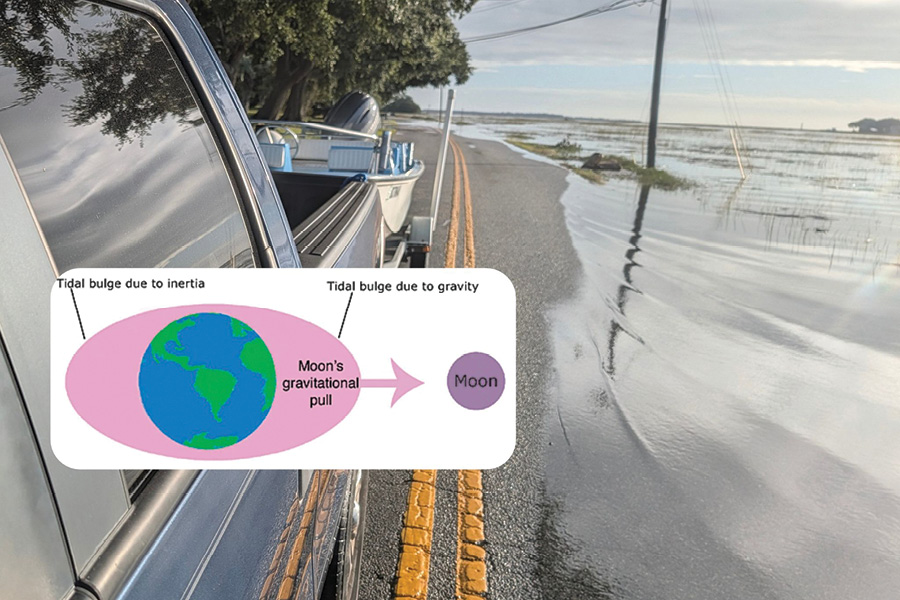
 A few mornings ago, I left for work, windows down, enjoying the chill in the air. The road winds right next to the marsh, and for the last few weeks, the sunrise has been perfectly timed for my drive to take my children to school. As I came around the curve along the marsh, ready to enjoy the view, the road abruptly disappeared. The tide was so high the road was several inches underwater, with ripples pushing into the yards across the street.
King Tides.
You don’t have to spend much time in the Charleston area to figure out that we flood. Downtown is infamous for folks kayaking down the streets during a heavy rainstorm, but many places just need an extra high tide. Many roads on Folly also flood during big tides (looking at you 9th Street West, a.k.a. the road to our wonderful home base at Sunset Cay Marina).
So why does this happen? Buckle up, this is an oceanography column.
Our area has semi-diurnal tides, meaning we experience two high tides and two low tides each day. The average difference between high and low tide is about 5.5 feet, but that range can vary dramatically.
Some days the water level rises only 4ish feet between tides, while others it can climb nearly seven. As I write this, the predicted tides range today from -0.08 to 6.9 feet. Are you dizzy from numbers yet? I am, and we still haven’t gotten to why this happens.
The tide is predominantly driven by the moon. The moon’s gravity has a stronger pull on the side closest to the moon and weakest on the opposite. These differences create two tidal bulges. Imagine the Earth surrounded by an ocean shaped like an oval (this is a weird thing to imagine, so look at the picture).
As the Earth rotates, land masses pass through the bulges, creating the rise and fall of tides. YouTube has some great videos if you’re so inclined to go beyond this very simplified model.
Ok, we know why tides happen, but what about the large variation?
During a full and new moon, the sun, moon, and Earth are aligned. This exerts a greater gravitational pull on the water, giving us a larger tidal range (Spring Tide). During a quarter moon phase, the Sun and Moon are at right angles to Earth, and their gravitational pulls offset, so tides are smaller (Neap Tide). This is why full/new moon high tides are more prone to flooding and exposing sandbars and mudflats you don’t always see in the estuary.
When the moon is at the closest point in its elliptical orbit around the Earth (called perigee, which is just a fun word to say), it has the strongest possible gravitational pull on the ocean. Add a full or new moon, and we can experience exceptional high tides, also called King Tides. Weather conditions such as strong onshore winds or storms can also raise water levels beyond predictions.
Want to learn more? The SC Aquarium has posted signs around the island with instructions for how to take a picture and submit it during a flooding event. NOAA has a fun interactive website to visualize all this. Next time you see a road disappear into the water, think about the moon and what’s happening above us. And if you find yourself driving through any sunny day puddles, be sure to rinse your car thoroughly.
Found something and want to know more about it? Send a photo to saltmarshadventure@gmail.com for help identifying and a chance to be in the next Creature Feature!