
LMMN works to protect Lowcountry dolphins, hosts fundraiser Nov. 22
by Liv Dennis | Contributing Writer
Along the waters surrounding Folly Beach, dolphins are more than a familiar sight. The local rivers and tidal creeks are home to resident dolphins that raise their young, build social bonds, and pass down hunting techniques, making the Lowcountry one of the few places in the world where a remarkable behavior known as strand feeding can be seen.
Helping protect these animals and the waters they depend on is the work of the Lowcountry Marine Mammal Network (LMMN), and it will host its fourth annual Fins and Flippers Fall Fundraiser on Sunday, Nov. 22 at Bowens Island Dockhouse.
The fundraiser, scheduled for 1- 4 p.m., will feature a traditional Lowcountry boil, steamed oysters, live music by Dallas Baker & Friends, beverages, and raffle prizes from local businesses. Proceeds will support the nonprofit’s marine mammal response, research, and education programs throughout coastal South Carolina.
For Lauren Rust, LMMN’s founder and executive director, protecting local dolphins starts with understanding how they live and the role they play in the Lowcountry’s coastal environment.
“What makes the dolphins around Folly Beach so special is how closely connected they are to the area’s coastal ecosystem,” Rust said. “From the Folly River and surrounding tidal creeks to the waters just off the beach, these dolphins are part of the fabric of the local environment.”
The dolphins found around Folly Beach are Tamanend’s bottlenose dolphins, a coastal species that inhabits the region year-round. Some have spent decades navigating the same waterways and have developed familiar routines and social bonds.
“What often surprises people is that dolphins have distinct personalities, complex social relationships and learned behaviors,” Rust said. “Residents and visitors may even encounter the same individual dolphins time and again without realizing it.”
One of the most unusual behaviors these dolphins display is strand feeding, a hunting technique seen in only a handful of places around the world.
“Strand feeding is a remarkable hunting technique where dolphins work together to herd fish toward the shoreline, creating a wave that pushes the fish onto exposed mudbanks,” Rust said.
The dolphins temporarily beach themselves on their right sides to catch the fish out of the water before sliding back into the estuary.
“It is a unique behavior, passed down from mother to calf, that requires precision, coordination and experience,” Rust said. “Not all dolphins strand feed, which makes observing this behavior in the local population especially fascinating.” LMMN has observed resident dolphins and their offspring feeding together, offering a glimpse into how the technique passes between generations.
The behavior also means dolphins can come remarkably close to shore, giving beachgoers an unusual opportunity to observe them. But that proximity makes it especially important for people to give the animals space.
“We are incredibly fortunate to live in a place where we can experience dolphins in their natural environment. But that privilege comes with responsibility,” Rust said.
Approaching, touching, chasing or feeding wild dolphins can disrupt their natural behavior and may violate the federal Marine Mammal Protection Act. LMMN encourages people to stay at least 50 yards from dolphins and avoid interfering while they feed.
With support from grants provided by the towns of Kiawah and Seabrook islands, the organization continues an outreach program that educates beach visitors about strand feeding and responsible wildlife viewing.
The nonprofit also studies individual dolphins through photo-identification research. Researchers use the unique markings, notches, and scars on dolphins’ dorsal fins to recognize animals over time and learn more about their movements, relationships, and health.
In 2024, LMMN received authorization from the National Marine Fisheries Service to conduct photo-identification work in the Charleston area. Weekly surveys in the Kiawah River help researchers better understand the local dolphin population.
Some of the dolphins have become familiar to researchers. Step, named for her distinctive, step-shaped dorsal fin, is the mother of at least five calves and is often spotted feeding alongside her offspring. The fin bears the effects of an old injury, allowing researchers to identify Step and track her over time. Rust described her as “a devoted mom and babysitter extraordinaire.”
Another dolphin, Koa, has drawn attention for a different reason. First observed in March 2025 without its tail flukes, Koa offers researchers a rare opportunity to learn how a wild dolphin navigates life with such a significant physical difference. Continued observations help LMMN document Koa’s movements and behavior while contributing to a broader understanding of the dolphins that inhabit local waters.
The organization’s work extends beyond research. LMMN leads the South Carolina Marine Mammal Stranding Network in partnership with the National Oceanic and Atmospheric Administration, responding to marine mammals that become stranded or distressed along the coast.
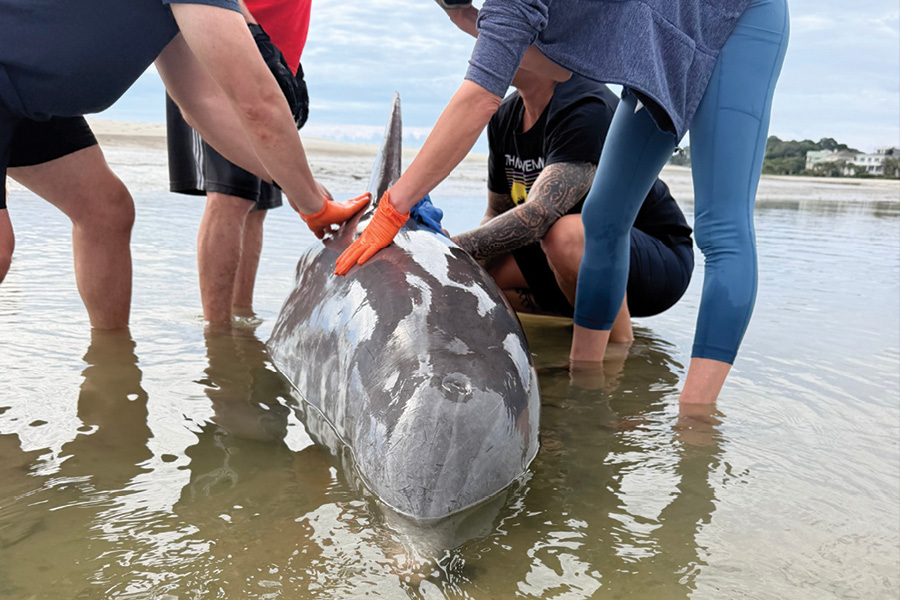
South Carolina typically sees about 50 to 75 marine mammal strandings each year, according to LMMN. The organization responds to both live and deceased animals, working with trained partners to assess conditions, conduct rescues when possible, and gather information that can help researchers understand marine mammal health and the coastal environment. One rescue this year involved Klaus, an adult male Tamanend’s bottlenose dolphin nearly 8 feet long that became stranded near Hilton Head Island in May as tidal conditions changed.
Responders kept Klaus shaded and comfortable while assessing his condition, then used a specialized rescue sling to return him to deeper water. Researchers at the University of South Carolina Beaufort later identified him by his distinctive dorsal fin.
LMMN had responded to 26 marine mammal strandings as of Rust’s interview, including two successful dolphin rescues. Each response provides an opportunity to help an animal when possible and learn more about the challenges marine mammals face.
The work relies on trained responders, partnerships and timely reports from the public. Anyone who encounters a marine mammal that appears stranded or in distress should call the South Carolina Marine Mammal Stranding Hotline at 800-922-5431 rather than attempting to approach or rescue the animal.
Education is another important part of LMMN’s mission. Through school programs, community events and its annual Dolphin Count, the organization gives residents opportunities to learn about local marine mammals and take part in conservation efforts. The Dolphin Count invites members of the public to observe and document dolphins from designated land-based locations, including a site on Folly Beach.
As LMMN approaches its 10th anniversary in 2027, Rust said community involvement remains essential to keeping its response, research and education programs going. The annual fundraiser helps provide resources for that work as funding becomes increasingly challenging to secure.
At the Nov. 22 event, attendees can enjoy an afternoon at Bowens Island while learning more about the animals that share the surrounding waters and supporting the people working to protect them.
For Rust, protecting dolphins means more than responding when an animal is in trouble. It also means helping people recognize the importance of the local waters these animals call home.
“These animals are not simply passing through Folly waters, this is their home and we are fortunate to share it with them,” Rust said.
For more information about LMMN’s work and the Fins and Flippers Fall Fundraiser, visit lowcountrymarinemammalnetwork.org.