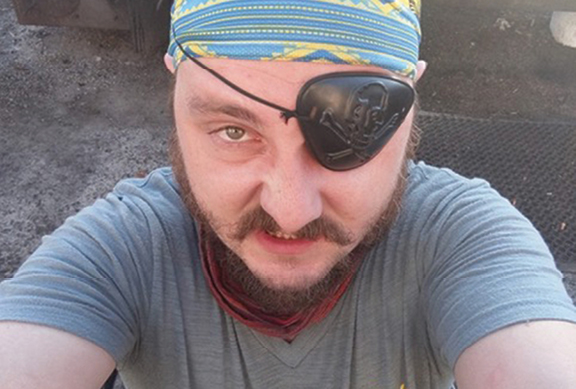
Greg Bunn shares stories, gratitude, and a push for better accessibility across the island
Walking Joel first introduced me to Greg, recommending him for an interview. I saw Greg often at Rita’s host desk, and every time I saw him, I promised him he would be up soon. At last, I can let him know that “Faces of Folly” is here!
Folly Current: Where were you born and how long have you been tied to Folly Beach?
Greg Bunn: I was born on James Island, and I’ve lived in Charleston my entire life, between James Island, Johns Island, downtown, and even a small stint on Folly Beach.
FC: What’s your favorite thing about Folly Beach?
GB: My favorite thing about Folly is the food and Bev community. I have ten years of experi-ence on Folly Beach, including six years at Snapper Jacks and four years now at Rita’s.
FC: What’s a Folly story that you’re fond of?
GB: It’s tough to choose a single favorite story from my time here, but the most memorable has to be when I was hit by a vehicle in October 2024.
The accident happened at a red light between McKevlin’s and Catch 23 after work; I followed all pedestrian rules but was struck by a driver who wasn’t paying attention.
An officer nearby recorded the incident on his body cam, and many witnesses and coworkers quickly came to help.
Though the crash was traumatic, community support—both at the scene and during my recovery—was incredible. While it took two weeks to heal, the love I received reminded me that Folly Beach will always feel like home.
FC: In your opinion what’s the most important issue facing Folly Beach?
GB: Accessibility for wheelchair users is a significant concern for Folly. Raising awareness about street crossing locations—particularly crosswalk ramps, which are essential for individuals using mobility devices—is critical. These areas are frequently overlooked, creating hazardous conditions when combined with inattentive drivers entering or leaving the island. Such circumstances have led to serious accidents, including injuries and fatalities.
If entering a business independently is impossible, the premises can be considered inaccessible. Similarly, if bathroom facilities do not accommodate mobility devices or require assistance to operate, accessibility needs are not met. Many older establishments in Folly and Charleston remain exempt from ADA compliance due to being grandfathered in before legislation, though improvements should still be pursued. Autonomous access is fundamental to true accessibility; these concepts must not be separated. Businesses that are inaccessible by choice demonstrate indifference to the needs of individuals requiring accessible environments.
FC: If you were in charge, how would you fix it?
GB: Cameras, particularly those capable of recording footage, represent progress in monitoring traffic. It remains uncertain whether lowering the speed limit would be effective, as many individuals currently disregard posted limits. Based on my observations, officers are diligent in maintaining a presence and monitoring Center; however, their capacity to be everywhere simultaneously is limited.
It is important to ensure that ramp ways remain unobstructed by gates or other barriers. Delays in gate removal after festivals can impede accessibility. Overall, the city’s infrastructure is generally reliable with respect to accessibility, provided drivers are attentive to pedestrians and access points are kept clear. Nevertheless, business accessibility presents more challenges. To address this issue, I recommend implementing additional regulations to enhance wheelchair access and ensuring their enforcement.
Pat “Wiggy” Hiban interviews a different “Face of Folly” for this column each month. If you have an idea of someone you think Pat should chat with, please send suggestions to editor@follycurrent.com.