
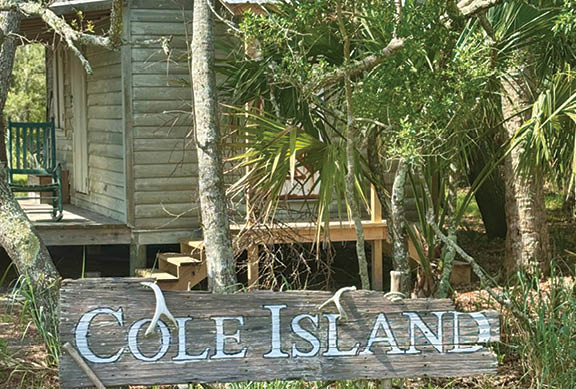
For more than two centuries, Cole Island has played a remarkable role in the nation’s story
by Lorne Chambers | Editor
Owning an island off the South Carolina coast has long been the stuff of fantasy. But Cole Island, a 300-acre secluded island between Folly Beach and Kiawah, offers something money rarely can. That’s the chance to become the steward of a place where some of the most consequential chapters of American history unfolded. Now, for the first time in decades, that opportunity is on the market.
Unlike most Folly Beach properties, Cole Island’s value isn’t measured only in its square footage or waterfront views. It’s measured in the stories embedded within its marshes and earthen fortifications—stories of revolution, war, freedom, and preservation.
As America celebrates its 250th birthday this year, few places in the Lowcountry illustrate the nation’s journey quite like this quiet island tucked between the Stono River and the Atlantic Ocean.
During the Revolutionary War, British forces bypassed the city’s primary defenses, slipping through Stono Inlet and marching over land to capture Charleston in 1780. This lesson wasn’t lost on military planners the next time around. During the War of 1812, Fort Palmetto was constructed on the strategically located Cole Island to ensure history would not repeat itself.
When civil war erupted a half-century later, Confederate leaders once again recognized the island’s geographic importance. Nine defensive batteries were built across Cole Island to guard Charleston’s “back door” and prevent Union forces from encircling the city from the southwest. Today, many of those earthworks remain visible, slowly disappearing beneath palmettos, live oaks, and marsh grass.
The island also played a role in one of the Civil War’s most celebrated stories.
Before his daring escape to freedom aboard the CSS Planter, an enslaved Robert Smalls helped remove artillery from Cole Island as Confederate forces abandoned the position. Smalls took over the Planter, sailed it past Confederate defenses, and surrendered the vessel, its cargo, and fellow enslaved passengers to the Union blockade on May 13, 1862. Smalls also provided valuable intelligence that Cole Island had been vacated. Within days, Union troops occupied the island, establishing an important foothold that they would hold for the remainder of the war.
Just over a year later, another chapter unfolded when members of the famed 54th Massachusetts Volunteer Infantry camped on Cole Island while awaiting transport to Folly Island before their assault on Fort Wagner. The heroic attack was later immortalized in the film Glory, which garnered Denzel Washington his first Oscar win.
THE CARETAKERS OF THE ISLAND
 Yet for all of its historical significance, Cole Island has remained largely untouched due to the careful stewardship of its private owners.
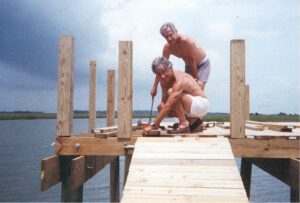
For the past three decades, that responsibility has rested with Charleston natives Mike and George Buero, twin brothers who purchased the island on their 58th birthday in 1994 after spending much of their childhood there.
“Our fathers began spending their summers on Cole Island as children after World War II,” said Matt Buero, Mike’s son and one of three current owners. “They were helping their uncle with his commercial fishing business alongside their grandfather and cousins. That was the beginning of their lifelong love for Cole Island.”
When the previous owners, the Sable family, decided to sell, they approached the twins.
“It was a childhood dream come true for them,” Matt said. “On our fathers’ 58th birthday, our family became the new caretakers of Cole Island.”
The island became far more than an investment.
The twins, both military veterans who later became Boeing 747 flight engineers, devoted decades to maintaining docks, cabins, and walking trails, and to preserving the island’s fragile ecosystem while researching and documenting its history. George passed away in December 2024, leaving Mike and the next generation of the family to continue that work.
“The responsibilities of owning a property this size with ecological and historical significance of this magnitude are overwhelming,” said Carmen Conley, George’s daughter and founding director of the Cole Island Foundation. “We really don’t know how our fathers were able to sustain it for over three decades.”
She credits not only her father and uncle but also an extended network of family and friends who helped maintain the island while carefully protecting its sensitive landscape.
“Our fathers shared their historical bounty with interested local organizations,” she said. “We’ve tried to build on that through research and greater access.”
Some of the family’s favorite memories have little to do with military history.
Marketing Director Marti Buero Merrell recalls hearing childhood stories about the twins checking fish traps in the middle of the night using lanterns because flashlights weren’t yet common.
Her favorite tale came after a hurricane unexpectedly swept across the island.
“Our fathers raised homing pigeons,” she said. “The morning after the storm, they tied a note to one of the pigeons that simply read, ‘All is well! Don’t call the Coast Guard!’”
Those family stories exist alongside discoveries that continue to deepen the island’s historical significance.
Merrell recently found a letter written from Cole Island by Col. Robert Gould Shaw, commander of the 54th Massachusetts, played by Matthew Broderick in Glory. The letter was to his wife Annie on July 17, 1863, the day before he was killed leading his regiment at Fort Wagner, which was on Morris Island.
“In the movie Glory, there’s a scene where he hands someone a bundle of papers before going into battle,” she said. “That letter would have been in those papers. I can’t imagine how Annie felt reading it, knowing her husband was not coming home.”
Matt Buero is equally captivated by the ordinary objects left behind.
“A clay pipe, a harmonica reed plate, and a golden uniform button,” he said. “These items were left behind by battle-weary soldiers who enjoyed a smoke while their buddy played the harmonica, knowing they could die the next day.”
THE FUTURE & LEGACY OF COLE ISLAND
Now, after more than 30 years of stewardship, the family believes it is time for someone else to write the island’s next chapter.
“There is never a perfect time to part with a place as special as Cole Island,” Conley said. “But after many years of stewardship, we believe this is the right time for the island’s next chapter.”
That next chapter officially began last month when the family listed Cole Island for sale. Folly Beach Realtor Carrie Rosen of Changing Tides Realty is marketing the property, which includes approximately 300 acres of highland and marsh, maintained walking trails, a dock, and two rustic cabins. The asking price is $6.5 million, but the family hopes prospective buyers will recognize that they are inheriting far more than a private island.
“Our hope is that Cole Island remains a place where its history, natural beauty, and cultural significance are respected and preserved,” she said. “Whether its future involves conservation, thoughtful private ownership, educational initiatives, or another compatible vision, we hope the next stewards will appreciate the island’s unique character and carry its legacy forward for future generations.”
That vision mirrors the dream Mike and George carried for decades. They imagined sharing Cole Island’s history through walking tours, educational programming, and careful public access. During their ownership, the family established marked trails, historical markers, a website documenting the island’s past, and, more recently, the Cole Island Foundation to encourage additional historical and environmental research.
“Cole Island wants to reclaim its spotlight in history,” Merrell said. “Many people don’t realize history recognizes Cole Island as Charleston’s back gatekeeper.”
For her, the island still has something to say. There are more stories to tell.
As America reflects on the events that shaped the nation’s first 250 years, Cole Island stands as a reminder that history isn’t always found inside museums or behind velvet ropes. Sometimes, the stories that helped shape this nation are lost to time. And then sometimes they are right there, just beyond the marshgrass.