
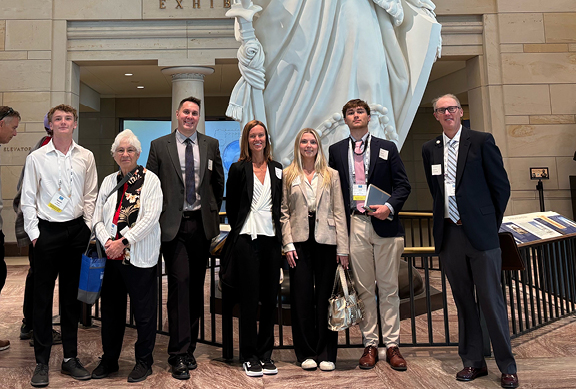
City leaders travel to nation’s capital for annual summit focused on protecting coastal communities
by Lorne Chambers | Editor
City of Folly Beach Mayor Chris Bizzell, Deputy City Administrator/Municipal Clerk Wes Graham, and Dr. Nicole Elko, the Executive Director of American Shore & Beach Preservation Association, made the trip to Washington, D.C. for the American Shore & Beach Preservation Association’s (ASBPA) Coastal Summit 2026. Held March 24–26, the Summit brought together coastal leaders from across the country for a policy-focused event centered on the future of the nation’s shorelines.
“One of the biggest takeaways for me was the momentum around establishing and funding a recurring Coastal Trust Fund. Having a reliable, dedicated funding source for resilience projects is critical for communities like ours, and it was encouraging to see that conversation gaining traction at a national level,” said Bizzell following the summit, which held added significance in that it was the organization’s 100th anniversary.
The three-day gathering brought together a wide mix of stakeholders—coastal engineers, local officials, federal agency representatives, environmental advocates, and researchers—all focused on protecting and managing America’s beaches and coastal communities.
“What stood out to me is that no coastal community is dealing with these challenges alone. The issues we’re facing—flooding, erosion, infrastructure resilience—are shared across the country,” said Bizzell. “That creates an opportunity for collaboration, but it also reinforces the need for consistent advocacy. For Folly Beach, that means continuing to tell our story, build partnerships, and push for solutions that are not just reactive but long-term and sustainable.”
The summit featured a series of panel discussions and presentations exploring the challenges facing coastal regions, including erosion, storm impacts, sea level rise, and the need for sustainable infrastructure. Participants also shared emerging science, policy strategies, and best practices to strengthen coastal resilience.
A key component of the event was its emphasis on advocacy. Attendees took part in “Advocacy Day” on Capitol Hill, meeting with members of Congress and staff to push for continued federal investment in coastal protection projects and programs. For the Folly contingent, that meant meeting with the staff of Sen. Lindsey Graham, R-S.C.
“I was very encouraged by the willingness of Senator Graham’s staff to engage with us directly and offer support,” said Bizzell. “It reinforced how important it is for local leaders to build relationships and advocate in person for the needs of our communities.”
Following the summit, Bizzell said the biggest opportunity moving forward for Folly Beach is to continue strengthening its relationships at the state and federal levels, which is key to identifying and navigating funding opportunities for larger, long-term projects.
More broadly, the summit underscored the need for federal agencies to shift from reactive approaches to proactive solutions, according to Bizzell.
“Our meeting with Senator Graham’s office is a good example. We were able to clearly communicate the long-term risks associated with flooding and the causeway over the next 20 years. That conversation quickly evolved into a willingness from their team to help us move,” Bizzell said. “We were able to clearly communicate the long-term risks associated with flooding and the causeway over the next 20 years,”
According to Bizzell, that conversation quickly evolved into a willingness from Sen. Graham’s team to help Folly Beach move forward.
“This exactly the kind of partnership needed for what will ultimately be a multi-agency, multi-year effort,” said Bizzell.
In addition to in-person sessions, the summit incorporated virtual “Agency Exchange” meetings with federal partners such as NOAA and the Bureau of Ocean Energy Management in the days leading up to the event, further expanding collaboration between policymakers and scientists.
“I think Folly Beach has done a strong job managing our dune system and overall beach preservation efforts. We’ve also made meaningful progress in recognizing the importance of marsh management and stormwater mitigation,” said Bizzell. “The Center Street project is a great example of that approach—identifying a long-standing issue, working collaboratively with multiple agencies, and securing the funding needed to deliver a transformative solution.”
According to Bizzell, proactive projects like this have a clear, highly measurable return on investment.
“Every $1 spent before a storm can save roughly $13 in recovery costs. That kind of forward-thinking approach is exactly what coastal communities need as we plan for the next 50 years.”