
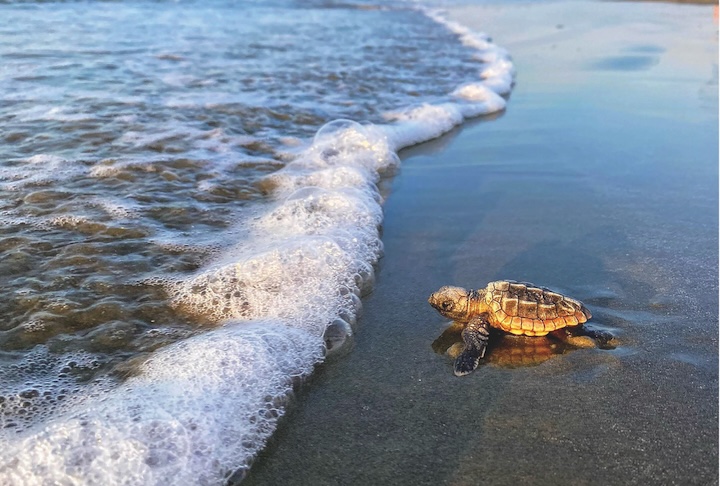
How Folly Beach Protects Its Sea Turtles
by Hanalei Potempa | Contributing Writer
May 1 marks the beginning of turtle season on Folly Beach, with water temperatures reaching 68–70 degrees Fahrenheit — warm enough for sea turtles to begin coming ashore to lay their nests.
Starting in early May, Folly Beach’s Turtle Watch volunteers walk the entire 7.1 miles of shoreline, especially at the beginning of the season, looking for evidence of nesting activity.
Adult sea turtles can weigh up to 300 pounds and stretch around four feet long, leaving easily identifiable tracks in the sand as they move from the water onto shore. If a nest is laid, the nesting body pit can span anywhere from seven to 10 feet wide.
Dave Miller, the permit holder for the Folly Beach Turtle Watch, ensures that all 65 volunteers are properly trained to participate in protection efforts such as nest identification and preservation.
Once volunteers find tracks, they search for eggs to confirm whether a nest has been laid. If so, they mark the area with stakes and orange tape to prevent disturbance.
“Then we just wait for 60 days or so until they hatch,” Miller says. “And so we do that all of May and all of June. And then by July, the early nests in May will start hatching. So when we’re walking in May, in June and in July, then not only are we looking for new nests, but we’re looking for hatching of the old nests.”
When a nest begins to hatch, about 100 hatchlings typically emerge and make their way toward the ocean. Volunteers wait three days before returning to inventory the nest’s contents, recording data such as the number of hatched and unhatched eggs and the incubation timeline. This information is entered into a national database.
One key piece of data collected is DNA testing, conducted in partnership with the University of Georgia. This allows researchers to track individual mother turtles and study nesting patterns over time.
For example, one turtle known as the “Folly faithful” laid 19 nests on Folly Beach over eight years, with an average distance of just 0.3 miles between nests. In contrast, another turtle, nicknamed “the wanderer,” laid nine nests over four years, ranging from Georgia to North Carolina, with an average distance of 237 miles between nesting sites.
Miller explained that while nesting patterns on Folly are somewhat predictable—most nests are laid by loggerhead turtles—the total number of nests varies each year because turtles only nest every few years.
“I think in 2019 we had 145 nests, and then last year we had 59 and so part of that is normal variation, because the sea turtles don’t nest every year. They nest every two, three, maybe four years.”
Occasionally, rare events occur. Miller recalled a green turtle nest laid in Garden City, South Carolina, which hatched after about 115 days, a much longer incubation period, with hatchlings emerging on December 23.
“By then it was too cold, so they had to take the hatchlings, and they took a boat out to the Gulf, where there’s a lot of seaweed, and they’re protected, and there’s food for them to eat,” Miller says.
The Turtle Watch team is trained to handle unusual situations like this, as well as to assist injured or endangered turtles. One of the biggest modern threats to sea turtle nests is artificial light, Miller noted.
“These creatures evolved before dinosaurs, and well before artificial light, and they are hardwired. When the hatchlings hatch, they’re hardwired to go to the light, which, for them, over the millions of years, has been the reflection of the moon and the stars and the clouds over the ocean,” Miller says.
Artificial lighting from beachfront homes, hotels, and streetlamps can confuse hatchlings, causing them to move away from the ocean and toward land.
“It’s really sad, because when a nest hatches and there is artificial light affecting that nest, every one of those hatchings will go in the wrong direction,” he says.
To combat this, Folly Beach enforces a “lights out” rule requiring residents and visitors to turn off lights after dark from May through October. Many public lights have also been replaced with turtle-friendly alternatives, such as those on the pier.
In addition to limiting artificial light, beachgoers are encouraged to remove trash and beach equipment and to fill in any holes they dig in the sand, as these can trap both hatchlings and adult turtles.
Miller shared that he has made many fond memories through his work with the Turtle Watch. One standout moment occurred when he received a call about a turtle nesting at around 9 a.m., after he had already completed his beach walk.
He described how the turtle remained determined despite encountering beachgoers in the water, even bumping into people before continuing onto shore to lay her nest.
“I would think that would cause a turtle to leave,” he says. “She was determined, and she kept on crawling. And she crawled up there, and there must have been 50 people watching her, me included, and she laid her nest.”
Other memorable experiences include watching hatchlings emerge and instinctively make their way to the ocean, as well as rescuing injured turtles and transporting them to the Sea Turtle Care Center at the aquarium.
Miller emphasized the importance of community involvement during turtle season. If you see a nesting turtle, an unmarked nest, or an injured turtle, call 843-588-2433. Even if you accidentally hook a turtle while fishing, he assures people they won’t be in trouble and urges them to call.
On Folly Beach, protecting sea turtles isn’t just a responsibility—it’s a tradition that brings the community together each summer.
If you see a sea turtle, nesting mother, or hatchlings on Folly Beach, contact Folly Beach Public Safety (FBPS) immediately at (843) 588-2433. They will notify the Folly Beach Turtle Watch Program volunteers to monitor the activity.