
City seeking public input before hiring outside consultant to study possible changes
by Lorne Chambers | Editor
Three years after Folly Beach voters narrowly approved a referendum capping the number of short-term rental (STR) licenses at 800, city leaders have begun a new review to determine whether the ordinance could be improved.
Newly elected mayor Chris Bizzell says Folly Beach City Council will host four meetings to create a list of concerns to present to an outside agency for an independent, unbiased review of the existing ordinance and assessment of its long-term impacts. Which independent, unbiased agency remains to be seen, but Bizzell says the council has earmarked $25,000 for the project and will issue a Request for Proposals (RFP) once the study’s parameters are defined.
“I want this to be as unbiased as possible. We’re not making any judgments or editorial comments. We’re not saying this is a good idea or a bad idea,” said Bizzell of the public comment process leading up to the RFP request.
“If we have these metrics in place, then we can quantify what the results are,” said Bizzell.
While the wheels of government often turn slowly, Bizzell says council intends to move fast with this in order to have it in place by next year. Two of the scheduled four public meetings have already taken place.
“This is something that was cited by the council as a strategic planning priority,” said Bizzell. “We’re hoping to have all of this in front of council by fall.”
The city plans to hold four public input meetings in total, with two already completed. According to Bizzell, comments gathered during the sessions will help shape the questions and issues presented to whichever outside firm is ultimately selected to conduct the review.
“We want to be forward-looking. We also want to involve a neutral third party that is objective and not tied to either the island or the industry, said Bizzell. “If they return and say something would be beneficial or detrimental to the community, then we can examine and amend the proposal accordingly.”
The first of four meetings was held at 10 a.m. on Thursday, May 14. Bizzell says the second meeting was moved to the evening so more people could attend and offer comments.
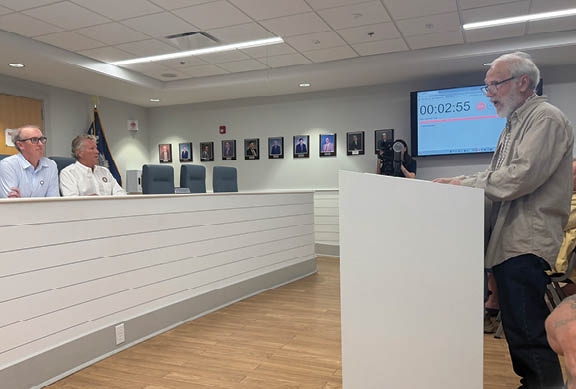
The second meeting, which was held at 6 p.m. on Wednesday, May 27, proved that opinions remained deeply divided on the issue. Residents have sharply differing views on the ordinance’s success or lack of success or what success even looks like.
At the beginning of the meeting, both Bizzell and city administrator Aaron Pope stressed that the objective was to identify areas that warrant further analysis and not to continue to rehash old battles and points of contention that have already been identified. But that didn’t stop residents from voicing their overall approval or displeasure of the way things have gone since the ordinance’s implementation three years ago.
The first speaker of the night was property owner John McFarland, who spoke on behalf of Save Folly’s Future, the grassroots organization that spearheaded the referendum effort. McFarland argued that the ordinance has already produced positive results.
“Long-term rentals are increasing, albeit very slowly. Today’s new builds are family-sized homes, not mini hotels. We have more accountability and better enforcement of STRs than we’ve ever had before. Quality of life has improved over the last few years,” McFarland said.
He urged council to focus on long-term impacts when considering any modifications.
“Preserving Folly’s residential community should be the highest priority during this process,” he said.
Others challenged the notion that the cap has delivered measurable benefits.
Local attorney Larry Powers, who said he purchased a home on Folly Beach in 2020 before eventually relocating to the island full-time, argued that city enforcement records do not support claims that short-term rentals are a major source of neighborhood problems.
“If there was a real major problem, licenses should be dropping like flies, and it’s not happening,” Powers said.
Calling the ordinance “a solution in search of a problem,” Powers criticized efforts to revise what he described as a fundamentally flawed piece of legislation.
“You know they say a camel is a horse designed by a committee,” he said. “I think our STR ordinance is a very old camel, and I don’t think you should be asking professionals to put lipstick on it for you.”
Fellow resident Regina Anderson, chair of the Folly Beach History Museum, used history to remind council that the cap originated through the same citizen referendum process that residents used decades ago to influence growth and development decisions on the island.
According to Anderson, nobody wanted to move to Folly in the 1980s because there was virtually no beach at high tide. She said that at that time, there were two camps among the residents: One was a group that wanted to bring significant development to Folly Beach. The other wanted to preserve the island’s character and ecology and work to combat erosion.
“Luckily, 40 years later, the will of the residents actually prevailed, and we do not have condos everywhere,” said Anderson. “What the residents did was they had a referendum. Sound familiar? Many years later, the same resident-driven referendum process was used for the cap.”
Others focused on the financial consequences of the ordinance.
Local resident Kate Peabody argued that the cap has limited opportunities for homeowners while doing little to address many of the quality-of-life concerns often attributed to short-term rentals.
“I’m a CPA by trade. So my very first concern when I heard about this was, ‘Man, this is going to hurt families. This is going to eliminate people’s financial safety net.’ And it did,” said Peabody.
She argued that most public nuisances and quality-of-life issues do not stem from STR renters vacationing on the island, but rather from day trippers, whom the STR cap does not directly address.
“Any issues that we have about livability on this island are coming from the day trippers, which we love. That’s why we love Folly. It’s for all,” said Peabody. “We are not a private island. We are a public island. So we got to figure this out. Work with the day trippers. There’s nothing that renters are adding or contributing that’s negatively affecting the quality of life on this island.”
Toward the end of the meeting, local realtor and Folly Association of Business President Vince Perna encouraged council to ensure that any review considers the broader community, including local businesses, workers, second homeowners, and visitors.
“Our community is made up not only of residents but also of local vendors, workers, second homeowners and visitors,” Perna said. “It’s unfair to dismiss these voices.”
There are two more public meetings to be held before the RFP seeking an outside consultant is finalized and issued for bid. According to Bizzell, council intends to incorporate the feedback from these meetings and from emails into the RFP. He says the resulting study is expected to examine the ordinance’s effectiveness, unintended consequences, and potential areas for refinement before the council considers any future amendments.
Bizzell, who was an outspoken proponent of the cap, and ran for council and mayor, largely riding that wave, says he is sincere in his efforts to improve the existing law to make it better for everyone.
“I’m not Pollyanna about it, but I hope that most people on the island think that we really looked at this and gave it a fair shake,” says Bizzell. “I don’t want to keep litigating this every four years.”