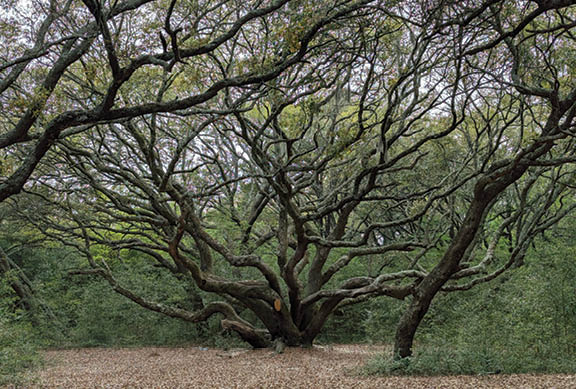
The barrier islands of today bear little resemblance to the ancient maritime forests that greeted early settlers
 We spend a decent amount of time outside, far from the crowds and out of sight of many of the signs of modern life. It’s easy to wonder how different the islands looked 250 years ago, or further back to when the first European settlers arrived in Charleston. I like to imagine that the big landmarks— where the barrier islands sat in relation to the harbor—were generally the same, but with a big dose of wild.
If you’ve ever tried to walk through the marsh, you know it’s inhospitable at best. The grass can be sharp, mud sucks at your feet, oysters threaten any exposed skin, and the bugs are relentless. Getting to one of the hammock islands set back in the marsh doesn’t make the going any easier. The underbrush is full of vines and prickly vegetation. Our islands are snake-y and spider-y (the 8-legged inhabitants alone are enough to keep me on the water and beach during the warmer months), and the mosquitoes treat bug spray like hot sauce. It wouldn’t have been easy going for the early settlers. But how much has the landscape itself changed in the last few hundred years?
Imagine it’s 1776: you’re stepping off the boat and making your way into an untouched maritime forest. You’re surrounded by enormous live oaks creating a cathedral-like canopy that offers protection from storms and blocks nearly all direct sunlight from filtering down. Magnolia trees offer flashes of white flowers. The middle height of the forest offers a surprisingly long view as medium-sized trees don’t have enough light to thrive. The understory is filled with shade-loving shrubs like red bay, yaupon holly, and wax myrtle, while saw palmettos dot the forest floor. A thick layer of pine needles and leaves on the ground add to the silence. No boat engines, no lawn mowers, no roads or houses breaking up the land. Only wind, leaves rustling, birds calling, and the inevitable hum of insects.
Late succession maritime forests are hard to come by these days. It is said that the Lowcountry was once filled with oaks as large as the Angel Oak. Many of these enormous trees were cut to build ships (and other framing endeavors), and it takes generations for young oaks to reach that size. The best “nearby” example I can think of for this today is part of the Turkey Walk Trail on Bulls Island or Hunting Island State Park. As you round a corner, you enter a stretch of forest that feels still, the undergrowth disappears, and everything opens as you walk up and down hills that are ancient sand dunes.
Today, many barrier island maritime forests are dominated by faster-growing pines. The smaller canopies allow more light through and more growth on the forest floor, creating the plant (and animal!) community we have today. The next time you’re walking the road to Lighthouse Inlet, look into the forest. Picture towering oaks and more open forest. Our coastline is in a constant state of change, and imagining the landscape as it came before us helps us appreciate—and protect—what we have today.
Found something and want to know more about it? Send a photo to saltmarshadventure@gmail.com for help identifying and a chance to be in the next Creature Feature!