“The Porgy House: A Cottage on an Island in a Culture” examines the birth of the acclaimed American opera on Folly Beach
by Regina Anderson | Contributing Writer
Joe, that’s George Gershwin! exclaimed Abe Dumas to his brother in 1934 at “a fine Folly Beach home,” where they’d just had dinner and wine and saw “two baby grand pianos there and scores of sheet music all over the place, just in disarray”.
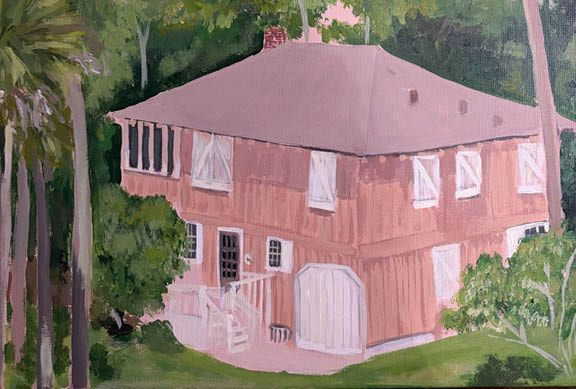
The Porgy House, sometimes referred to as “Follywood” by it’s first owners, the authors DuBose and Dorothy Heyward, is still located a 712 West Ashley Ave. and is the subject of a new small exhibit in the Folly Beach Community Center.
Presented by the Folly Beach Historical Society “The Porgy House: A Cottage on an Island in a Culture” examines the birth of the acclaimed American opera, Porgy and Bess, from the original novel “Porgy” to the first production of Porgy and Bess to be performed in Charleston, 35 years after it was written and after it had played countless times nationally and internationally.
In his 1996 oral history by the Jewish Heritage Collection at the College of Charleston, Dumas recalls meeting Gershwin on the beach and later driving (he had a car!) him around to African American churches to hear gospel music and experience some of the local Gullah Geechee culture of the Lowcountry. The unique sounds and cadences of that culture can be found in every production of Porgy and Bess.
The Heywards had insisted that Gershwin spend time in Charleston and Folly to get a feel for the people they wanted to portray in the piece and to experience the laid-back lifestyle of the beach. Gershwin stayed in a cottage on the now underwater upper West Arctic Ave. but the libretto and music for Porgy and Bess was a Heyward/Gershwin collaboration written on Folly Beach 92 years ago in that salmon-colored house, inside of which today it still feels like the 1930’s.
Gershwin’s cousin, the painter Henry Botkin, accompanied him to Folly in 1934 and made several paintings and sketches depicting Folly Beach and Gershwin’s time here. The Gibbes Museum of Art has a number of them, depicting both Folly and Charleston. The Charleston Museum has the actual piano which Gershwin rented for use on Folly on display and the South Carolina Historical Society has several photographs of the house from that period (loaned for this exhibit).
First performed in Boston and New York in 1935 the opera has been staged all over the world and in 1959 was made into a movie starring Sidney Poitier and Dorothy Dandridge. However, due to the ongoing segregation of audiences in Charleston the opera was not performed where it was written until 1970. For that production famed NY director Ella Gerber directed a local cast of 120 non-professionals, all but two African Americans. Porgy was portrayed by Reuben Wright and Bess by Dr. Annette McKenzie Anderson. The Folly Beach Historical Society exhibit includes the program for and original photographs of that production. A documentary by Lauren Waring Douglas entitled “When Porgy Came Home” is in the works about that 1970 production, clips of which were just shown at Spoleto. Spoleto also hosted a production in 2016, with visual designs by artist Jonathan Green, himself of Gullah descent.
The Charleston Stage has hosted three productions of the play “Gershwin at Folly” by Julian Wiles. The musical production explores that time period on Folly Beach and the birth of the opera created by Heyward and Gershwin – several scenes set at the “Folly Beach Pavilion”. Recently a class from the American College of Building Arts has measured, drawn and documented the Porgy House and some of their findings are in the exhibit. In fact the Historical Society’s exhibit’s title comes from their project. The house is currently owned by the Glick family.
So..wherever you are in the world, the next time you hear “Summertime, and the Livin’ is Easy…” you’ll know it all started right here on our little island.